How Much Does a Wireless Dog Fence Cost?
A wireless dog fence usually costs more than a basic wired kit but less than a full physical fence, and the kit you buy matters more than any monthly fee. Most homes pay for a transmitter, one collar, training flags and batteries, then add collars only if they have more dogs.
On this page (9 sections)
- How much does a wireless dog fence cost in total?
- What is included in a wireless fence kit?
- What drives the price up or down?
- Do wireless dog fences have monthly fees?
- Which extras add to the bill?
- Is a wireless fence cheaper than a wired fence or a physical one?
- How do you keep wireless fence costs low?
- Which wireless fence system offers the best value?
- What should you budget for in year one?
A wireless dog fence usually costs a single up-front kit plus small running costs, and the kit you buy matters more than any monthly fee. Most homes pay for a transmitter, one collar, training flags and batteries, then add a collar for each extra dog.
If you're weighing how much a wireless dog fence costs against a physical fence, the answer is usually clear: a wireless setup is the smaller bill for most yards. The money goes into the electronics, not posts and panels.
How much does a wireless dog fence cost in total?
Budget around the price of one good kit for the first dog, then a much smaller amount per extra dog. The system is a one-time buy, and there is no fence crew, no digging and no concrete.
Prices on the boxes move around, so compare sellers rather than trusting one number. What stays steady is the shape of the cost: one transmitter, one collar, then add-ons.
It also helps to price the kit against what it replaces. A wired fence needs boundary wire buried in a trench around the whole yard, plus a transmitter to drive it.
A wireless kit skips the wire entirely and needs only a power outlet, so the hardware and the labor both shrink.
What is included in a wireless fence kit?
A standard kit includes the transmitter, one receiver collar, training flags, a test light tool and contact points. Some kits also include the collar battery.
That means the first purchase covers the basics for a single dog. You don't need to buy flags or tools separately to get started, which keeps the first bill simple.
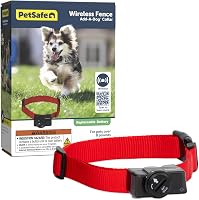
The PetSafe Wireless Dog Fence, up to 1/2 acre, is the classic version of that kit. It covers a circular area up to 1/2 acre from the transmitter, and the collar fits dogs 8 lb and up.
The Stay & Play Compact goes slightly further. It reaches up to 3/4 acre, has an LCD screen showing the boundary distance, and ships with a rechargeable collar.
What comes in the Stay & Play Compact box?
The Stay & Play kit includes the transmitter with power adapter, the receiver collar, a receiver charger, a PetSafe rechargeable Li-ion battery that is not replaceable, training flags, a test light tool, long contact points and a contact point wrench. Because the battery is built in, there is no separate battery to buy at setup.
The LCD screen also warns you if the system has an error. That display is useful when you adjust coverage for a smaller dog or a tighter yard.
What drives the price up or down?
Coverage, collar type and dog count are the three levers. A bigger boundary needs a bigger kit, a rechargeable collar saves on batteries later but costs more now, and every extra dog means another collar.
Collar features also move the number. A waterproof collar with adjustable correction levels suits most dogs, while extra contact points help dogs with long or short coats.
Both PetSafe collars in this lineup fit neck sizes 6 to 28 in, so the fit range is not what separates them.
Where you buy matters less than what's in the box. Two kits with the same coverage can differ because one includes a rechargeable collar and the other runs on replaceable batteries.
Dog size matters too. The standard kit fits dogs 8 lb and up.
The Stay & Play collar fits dogs 5 lb and up, which matters for a very small breed.
Do wireless dog fences have monthly fees?
Most do not, so the running cost is the collar battery. PetSafe says its standard collar battery lasts up to 2 months, and the add-a-dog collar runs 1 to 3 months depending on use.
That is the real "monthly fee" for many homes: a battery every couple of months. A rechargeable collar replaces the battery with charging time, which is why the Stay & Play Compact can cost less to own over several years.
GPS-based systems are different. Some use a subscription for mapping and tracking, so ask before you buy if you plan to use GPS features.
A wireless radio fence like these PetSafe units has no app and no subscription to manage.
How do the two collar types compare on running cost?
The standard collar takes a PetSafe RFA-67D-11 battery and alerts you with a low battery indicator when it needs replacing. The add-a-dog collar runs on the same battery and lasts 1 to 3 months depending on use.
The Stay & Play collar uses a rechargeable Li-ion battery that is not replaceable, so you charge it instead of buying cells. Over a few years the rechargeable route removes the repeated battery purchase.
Which extras add to the bill?
Extra collars, replacement batteries and a second transmitter are the usual add-ons. Add a collar only when you add a dog, and buy batteries in advance so a low-battery warning doesn't leave the fence off.
The PetSafe add-a-dog collar is the cheapest way to bring a second pet onto the same system. It works with all PetSafe wireless fence transmitters and fits neck sizes 6 to 28 in.
Second transmitters come into play only on large properties, where one unit can't reach the whole yard. PetSafe notes that coverage can be expanded further with the purchase of an additional transmitter.
If your yard sits at the edge of a kit's range, price the second unit before you buy the kit, because it changes the total.
Is a wireless fence cheaper than a wired fence or a physical one?
Yes, for most homes. A wired invisible fence needs a boundary wire buried around the yard, which means installation labor or a long weekend with a trencher.
A physical fence is priced by the linear foot and often runs into four figures.
We compared the full range in our guide to how much an invisible fence for dogs costs, which lines up wired, wireless and GPS. If you want the wired breakdown on its own, see how much does an invisible dog fence cost.
For small and medium yards, wireless usually wins on price. For an irregular lot with a house, shed or pool edge in the middle, a wired fence can be worth the extra because it follows the shape you draw.
How do you keep wireless fence costs low?
Buy the kit that matches your yard and dog count, then protect the collar. A kit that's too small leads to a second transmitter, and a kit that's too big is money spent on range you don't use.
Measure first. The standard kit adjusts coverage from 5 to 90 ft in all directions from the transmitter, or up to 180 ft across.
A long narrow yard may not suit a single transmitter, while a square yard is the easiest fit.
Keep the transmitter indoors, dry and plugged in, and use a surge protector if you get storms. Replacing a transmitter is the biggest single cost after the kit itself.
Buy standard batteries in a multi-pack if your collar uses them, and keep the low-battery indicator in view. Our best wireless dog fence roundup ranks the current options by coverage and collar.
Which wireless fence system offers the best value?
The PetSafe Wireless Dog Fence, up to 1/2 acre, is the best value for most single-dog yards. It fits small, medium and large dogs at 8 lb and up, and the collar is waterproof.
PetSafe says it was awarded best wireless dog fence overall by Forbes.
Its score of 8.9 is the highest of our wireless picks. The coverage is adjustable from 5 to 90 ft in every direction, and it can be expanded with an extra transmitter.
The collar runs on a standard battery that lasts up to 2 months, so a spare cell in the drawer covers the first warning.
The Stay & Play Compact scores 8.7 for homes with a bigger yard. Its 3/4 acre boundary and rechargeable collar suit dogs 5 lb and up.
The add-a-dog collar scores 8.6 and exists for one job: bringing a second or third dog onto the same transmitter. Households with one dog don't need it.
If you're already leaning PetSafe, our best PetSafe wireless dog fence comparison goes deeper on the models.
What should you budget for in year one?
Plan for the kit, one spare battery, and any extra collar your household needs. That covers the setup and the first low-battery warning.
Add a little for training treats and time. The fence only works if your dog learns the boundary, so the first week or two is a training project, not an electronic one.
The kit includes training flags and a test light tool, which is why the training cost is mostly your time rather than extra gear. Both collars offer a tone-only mode plus five levels of correction, so you can start gentle and adjust as your dog learns.
After year one, the budget gets small. A battery every month or two, or a charge routine with a rechargeable collar, keeps the system running.
The main risk to avoid is buying a second kit when one collar would do. PetSafe says unlimited collars can share one transmitter, so the fence scales by collar, not by kit.
Whichever way you total it, how much a wireless dog fence costs comes down to your yard and your dogs. Match the kit to both, and the number stays predictable.
Frequently asked questions
How much does a wireless dog fence cost to run each month?
Most wireless fences have no subscription. Your ongoing cost is collar batteries, and PetSafe says the standard collar battery lasts up to 2 months.
A rechargeable collar swaps that battery bill for charging time instead.
Do you pay more for a bigger yard?
Yes, usually. A standard kit covers up to 1/2 acre, and a compact system reaches about 3/4 acre with a wider range.
Yards beyond that need a different approach, such as multiple transmitters or a GPS-based system.
How much does it cost to add a second dog?
You buy one extra receiver collar per dog rather than a second fence. That keeps the total well below a second full kit, and PetSafe says unlimited collars can share one transmitter.
Budget for the collar plus its battery.
What hidden costs should you plan for?
Plan for batteries, a replacement collar if one fails, and training time. Some households also need a longer power adapter or a second transmitter to reach the full yard.
None of these are surprises if you budget for them up front.
Can you take a wireless fence on holiday?
Yes, the PetSafe systems are portable and run from any outlet. That means one purchase covers home and travel, with no second setup cost, as long as you can place the transmitter safely at both locations.