8 Best Wireless Dog Fences for Two Dogs (November 2026)
The best wireless dog fences for two dogs include the Safehalo GPS wireless fence for 2 dogs for different dog routines, the Htcuto wireless dog fence for 2 dogs for fence and recall training, and the FOCUSER wireless dog fence for 2 dogs for shared home yards.
On this page (8 sections)
- How we chose wireless dog fences for two dogs
- Compare wireless dog fences for two dogs
- The best wireless dog fences for two dogs
- How to choose a wireless dog fence for 2 dogs
- How should you set up a two-dog wireless fence?
- How do you care for two fence collars?
- Which two-dog fence mistakes should you avoid?
- Which wireless dog fence should you choose for two dogs?
The Safehalo wireless dog fence for 2 dogs is our top pick for dogs that need separate boundaries. Choose the PetSafe replaceable-battery kit for a shared circular yard, or Htcuto if you also want remote training.
Two collars are only the starting point. Both dogs need a suitable fit, a boundary they can learn and a daily routine that keeps their collars ready.
For a wider overview, start with our complete guide to wireless and GPS dog fences. Compare the best wireless dog fences for other household needs, or read about wireless fence setup and operation before planning your boundary.
Our picks at a glance
-
1
 Best for different dog routines
Safehalo GPS wireless fence for 2 dogs
7.7/10 our score
See it on Amazon -
2
 Best for fence and recall training
Htcuto wireless dog fence for 2 dogs
7.6/10 our score
See it on Amazon -
3

- 4
 Check it
PetSafe Stay & Play wireless fence, 2 dogs
Best for battery swap routines - 5
 Check it
DJNFGQ GPS wireless fence 2-pack
Best for irregular outdoor areas - 6
 Check it
PetSafe Stay & Play 2-dog wireless fence
Best for rechargeable PetSafe households - 7
 Check it
Htcuto wireless dog fence with 2 collars
Best for individual remote commands - 8
 Check it
zvsay wireless dog fence for 2 dogs
Best for low light visibility
How we chose wireless dog fences for two dogs
We compared boundary control, collar fit, power needs and two-dog operation. The scores reflect those features and their usefulness for a two-dog household.
We favored clear support for both dogs, practical feedback controls and useful choices between shared areas and separate zones. Unclear collar counts or fit details matter because they can leave one dog without suitable equipment.
These systems give alerts or corrections rather than physically blocking an exit. A road-facing yard, a dog that bolts after wildlife or a dog that becomes frightened by feedback may need a different containment plan.
Compare wireless dog fences for two dogs
Choose the boundary style first, then compare collar fit and power. A large maximum range cannot make a circle fit a narrow strip of lawn.
| Product | Best for | Boundary | Dogs | Power | Our score |
|---|---|---|---|---|---|
| Safehalo GPS wireless fence for 2 dogs | different dog routines | 65–9,840 ft radius or 3–6-sided custom shape | 2 independent collars; confirm fit for dogs under 20 lb | Rechargeable; up to 48 hours per collar | 7.7 |
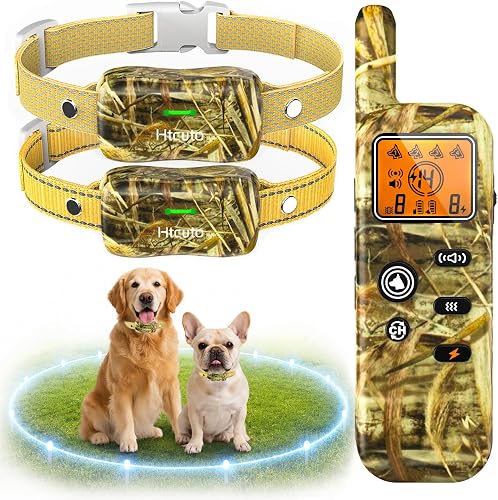
| Htcuto wireless dog fence for 2 dogs | fence and recall training | 25–3,500 ft; 14 levels | Up to 2 in fence mode | Rechargeable; up to 84 hours in fence mode | 7.6 |
| FOCUSER wireless dog fence for 2 dogs | shared home yards | 25–300 m radius | Two-dog system; 10–110 lb | Rechargeable collars; transmitter plugs in | 7.5 |
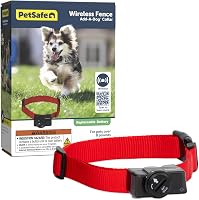
| PetSafe Stay & Play wireless fence, 2 dogs | battery swap routines | Circular, up to 3/4 acre | 2 collars included; 5 lb and up | Replaceable collar battery; up to 2 months | 7.3 |
| DJNFGQ GPS wireless fence 2-pack | irregular outdoor areas | 49–6,561 ft radius or polygon | 2-pack; confirm collar fit | Rechargeable; up to 24 hours | 7.0 |
| PetSafe Stay & Play 2-dog wireless fence | rechargeable PetSafe households | Circular, up to 3/4 acre | Confirm collar count before ordering | Rechargeable receiver collar | 7.0 |
| Htcuto wireless dog fence with 2 collars | individual remote commands | 25–3,500 ft; 14 levels | 2 in fence mode; remote supports up to 4 compatible collars | Rechargeable; up to 84 hours in fence mode | 6.9 |
| zvsay wireless dog fence for 2 dogs | low light visibility | Up to 985 ft radius | Two-dog system; confirm collar fit | Rechargeable transmitter and receiver | 6.9 |
The best wireless dog fences for two dogs
Safehalo leads for independent boundaries, while the other picks serve shared yards, battery preferences or remote training needs. Read the skip advice as closely as the benefits.
Safehalo GPS wireless fence for 2 dogs: Best for different dog routines
- Two independent GPS collars
- Circular or custom boundary per collar
- No monthly fees
- Up to 48 hours per charge
Separate boundaries and feedback settings let you match each collar to its dog. Choose this GPS pair for open outdoor properties where the dogs need different activity areas.
Pros
- Independent boundaries and feedback controls
- Circular and custom shapes
- No base station or monthly fees
Cons
- Needs suitable outdoor satellite reception
- Each collar requires its own setup
Safehalo is the strongest choice when each dog needs its own activity area. One collar can use a circle while the other uses a custom 3–6-sided shape, without changing its partner's settings.
Each collar also has independent beep, vibration and static controls, with options to disable individual outputs. That helps when one dog responds to a sound cue while the other needs a different training approach.
Fence Memory can restore each saved boundary when the collar powers on at the same location. Safehalo claims up to 48 hours per charge, and both collars have IPX7 protection.
The neck range is 12–28 in, but Safehalo gives minimum weights of both 15 and 20 lb. Confirm suitability for a dog under 20 lb.
Skip it for indoor containment or a property without suitable satellite reception. Read whether GPS dog fences work in wooded areas if trees cover much of your usable yard.
Htcuto wireless dog fence for 2 dogs: Best for fence and recall training
- Two-dog fence mode
- Remote training up to 6,000 ft
- Boundary adjusts from 25–3,500 ft
- No app or subscription
A combined fence and remote training system suits households that also want to practice recall. Choose between beep-and-vibration boundary feedback and a mode that adds static.
Pros
- Fence and remote training functions
- Two dogs supported in fence mode
- Fence mode can omit static
Cons
- Remote is not waterproof
- Four-dog remote support does not extend to fence mode
Htcuto suits households that want boundary alerts and remote training in one system. Its fence mode offers beep and vibration alone or a response that adds static correction.
The fence distance adjusts from 25–3,500 ft across 14 levels. Htcuto claims a remote training range of up to 6,000 ft, but that separate figure should not guide your fence layout.
Two dogs can use fence mode, while remote training supports up to 4 dogs. Expanding remote training capacity does not expand the number of dogs supported by the fence.
The collars fit dogs from 10–130 lb. Htcuto claims about 2 hours to recharge and up to 84 hours of operation in fence mode.
Choose it if you'll use individual training commands as well as a boundary. Skip it if you need confirmed independent custom zones, and keep the non-waterproof remote dry even though the receiver collars are IPX7.
FOCUSER wireless dog fence for 2 dogs: Best for shared home yards
- Plug-in transmitter
- Two-dog containment system
- 25–300 m radius
- IP67 receiver collars
A plug-in transmitter creates a shared area without buried wire. It suits a home yard with a suitable mounting spot higher than 3.5 ft.
Pros
- No wire burial
- 16 boundary levels
- Rechargeable collars
Cons
- Needs a suitable transmitter location
- Cannot trace an irregular property line
FOCUSER fits two dogs sharing a home yard around a fixed transmitter. Its adjustable radius runs from 25–300 m, with 16 boundary levels and 4 correction levels.
The collars fit dogs from 10–110 lb with necks from 8–21 in. Check the neck limit carefully if one dog is broad through the shoulders and neck.
Plan the transmitter location before buying. FOCUSER calls for wall placement higher than 3.5 ft, so a low shelf beside an outlet is not a suitable default.
The rechargeable collars have IP67 protection for wet outdoor use. Charge each for at least 4 hours before first use, and watch for the flashing red low-battery indicator.
Choose FOCUSER when a shared signal area fits the yard and you have a suitable mounting spot. Skip it when the useful lawn runs around corners or requires a boundary that follows several property edges.
PetSafe Stay & Play wireless fence, 2 dogs: Best for battery swap routines
- Two collars and boundary flags included
- Circular boundary up to 3/4 acre
- Portable transmitter
- Replaceable collar batteries
Two included collars and boundary flags make this a clear choice for a shared circular yard. Replaceable batteries suit buyers who prefer battery swaps over charging collars.
Pros
- Two collars included
- Boundary flags included
- Static-free reentry
Cons
- Circular boundary only
- Replacement collar batteries are an ongoing need
This PetSafe kit is the clearest option here for two included collars with replaceable batteries. It creates a circular area up to 3/4 acre and includes flags for boundary training.
The collars fit pets 5 lb and up, with neck sizes from 6–28 in. That makes this a useful starting point when one dog falls below the minimum weight of several other picks.
PetSafe claims up to 2 months of collar battery life. The collars use RFA-67D-11 batteries and have a low-battery alert, so keep replacements available rather than waiting for both collars to run low.
Static-free reentry lets a dog return without correction on the way back. The portable transmitter needs an outlet, including at a vacation home or campsite.
Choose it for a shared circle and battery swaps. Skip it if you want custom zones or rechargeable collars; compare the best wireless dog fences if those needs matter more.
DJNFGQ GPS wireless fence 2-pack: Best for irregular outdoor areas
- GPS fence 2-pack
- Circular or free-form boundary
- No monthly fee
- Up to 24 hours per charge
Circular and polygonal GPS modes suit outdoor areas that need more shape control. Plan a regular charging routine and confirm collar fit before choosing this pair.
Pros
- Circular and polygonal boundaries
- No buried wire
- No monthly fee
Cons
- Outdoor use only
- Dog weight and neck fit need confirmation
DJNFGQ suits an outdoor area that needs a polygon rather than a circle. Its circular mode covers a 49–6,561 ft radius, while the free-form mode uses multiple vertices to define a custom zone.
A polygon can fit an angled lawn better than a circle. Still, leave room inside property edges rather than tracing a road, pond or neighboring driveway exactly.
DJNFGQ claims up to 24 hours of operation and about 3 hours to recharge. With two collars in daily use, plan a charging window during a walk, indoor rest or another period with separate containment.
The collars are IPX7, but the system is for outdoor use only. Confirm both dogs' weight and neck fit before choosing it.
Buy this pair for shape flexibility when a regular charging routine works for you. Skip it if you need explicit confirmation that each dog can keep a different boundary; Safehalo states that capability clearly.
PetSafe Stay & Play 2-dog wireless fence: Best for rechargeable PetSafe households
- Circular boundary up to 3/4 acre
- Rechargeable receiver collar
- Tone-only mode and 5 static levels
- Boundary flags included
This rechargeable PetSafe option suits a shared circular yard and travel with an outlet. Confirm the package contains two collars because PetSafe gives conflicting package counts.
Pros
- Rechargeable receiver collar
- Tone-only mode
- Static-free reentry
Cons
- Circular boundary only
- Included collar count needs confirmation
This PetSafe model suits buyers who want a rechargeable collar within a shared circular system. It offers tone-only mode, 5 static levels and static-free reentry.
The boundary adjusts up to 3/4 acre, and the portable transmitter needs an outlet. It fits a home yard or travel location where the same circular approach makes sense.
Confirm the included collar count before ordering. PetSafe describes both a two-collar kit and a package containing one rechargeable collar, so resolve that conflict before relying on it for both dogs.
The receiver fit starts at 5 lb with a 6–28 in neck range. Boundary flags help give each dog a visible reference during introduction.
Choose this option when you prefer recharging and can confirm the complete two-dog package. Skip it for irregular property lines; our GPS vs wireless dog fence guide explains how shape and placement change the choice.
Htcuto wireless dog fence with 2 collars: Best for individual remote commands
- Two receiver collars
- Fence and remote training modes
- Up to 3,500 ft boundary
- No app or monthly subscription
Separate remote channels let you select one dog for a training command. Save each dog's feedback settings before entering the shared circular fence mode.
Pros
- Two collars included
- Individual remote channels
- Fence mode has a no-static option
Cons
- Remote is not waterproof
- Feedback levels cannot change while fence mode is active
This Htcuto model suits owners who want to select each dog by remote channel during training. It includes two collars and lets both dogs use its circular fence mode at the same time.
Save each dog's vibration and static levels before entering fence mode. Those levels cannot change while fence mode is active, so make adjustments during a planned pause with both dogs secured.
The boundary adjusts from about 25–3,500 ft across 14 levels. Walls, metal, terrain and nearby interference can affect the actual operating distance.
Collars fit dogs around 10–130 lb with necks up to 23.6 in. Htcuto claims up to 84 hours of fence-mode operation and about 2 hours to recharge.
Choose it for shared containment plus individual remote commands. Skip it if you expect to change feedback levels during active fence use, and protect the non-waterproof remote even though the collars have IPX7 protection.
zvsay wireless dog fence for 2 dogs: Best for low light visibility
- Fence and remote training modes
- Boundary up to 985 ft radius
- Three training modes
- IP66 receiver
Reflective collar material adds visibility for supervised outings in low light. Choose it only after confirming both dogs' fit and the boundary shape you need.
Pros
- Fence and training modes
- Rechargeable transmitter and receiver
- Reflective collar material
Cons
- Boundary shape needs confirmation
- Dog weight and neck fit need confirmation
The zvsay system is worth considering when reflective collar material helps with supervised low-light outings. Its fluorescent TPU strap can make a collar easier to spot, though it does not show a dog's location.
It combines fence and remote training functions with a boundary radius up to 985 ft. Sound, vibration and static modes offer 9 adjustable levels.
Both the transmitter and receiver are rechargeable. The IP66 receiver suits rain, wet grass and splashes; do not treat that protection as permission for swimming or prolonged immersion.
Confirm the dogs' weight and neck fit, as well as the boundary shape, before choosing this system. Those details matter more than the reflective finish when deciding whether it fits your household.
Choose it if those checks suit both dogs and you want its combined functions. Skip it when you need clearly defined custom zones, known fit limits or more detailed power planning.
How to choose a wireless dog fence for 2 dogs
Match the usable yard and both dogs before choosing extra features. Work through boundary shape, collar fit, individual controls and power in that order.
Do your two dogs need separate wireless fence boundaries?
A shared area is simpler when both dogs use the same lawn. Separate boundaries help when one dog needs a smaller activity zone or access to a different part of the property.
Do not confuse separate correction settings with separate zones. A system can save different feedback levels for each collar while keeping both dogs inside one shared boundary.
Also consider how the dogs interact. If one follows the other everywhere, separate electronic boundaries may be harder to teach without gates, leashes or planned outdoor turns.
Will both collars fit properly?
Check weight and neck size for each dog, then follow the collar's fitting instructions. Meeting a weight minimum does not guarantee that a bulky receiver sits well on a particular neck.
Measure where the receiver will sit rather than copying the size of a loose everyday collar. Check contact-point guidance for thick coats without overtightening the strap.
For a much smaller second dog, compare wireless dog fences for small dogs. Do not size the whole system around the larger dog and assume the smaller one can wear anything.
Does the usable yard fit a circle?
Sketch the lawn, house, driveway and hazards before choosing a boundary. A circular fence may cover less useful grass than its maximum acreage suggests.
Moving a transmitter changes where its signal area falls. Increasing the radius to reach a far corner may also extend the boundary into a place you want to exclude.
GPS shape controls can help with angled spaces, but a polygon still needs room for positioning variation. For a narrow or tightly divided yard, compare wireless, GPS and wired dog fences before settling on wireless.
Which power routine can you maintain?
Choose a routine that keeps both collars ready every day. Claimed runtime is a planning guide, so check actual battery status before outdoor use.
Label the collars and charging positions so you know which belongs to each dog. With replaceable batteries, keep the correct spares available and check each collar separately.
Do not leave one dog outside without a working collar while its partner's collar charges. Use a leash, a secure physical enclosure or indoor time during that gap.
How should you set up a two-dog wireless fence?
Map and check the boundary without either dog wearing a receiver, then teach each dog separately. Setup and boundary training are different jobs.
Establish the boundary before introducing either dog
Place a transmitter where its instructions require, or take GPS collars into a suitable open outdoor area. For Safehalo's initial satellite fix, keep the powered collar still for 1–2 minutes.
Walk the intended boundary with each receiver according to its manual. Use any included checking tool as directed, and note where alerts begin near corners, slopes, buildings and access points.
Check both collars rather than assuming they respond in the same place. For separate zones, label a simple yard sketch with each dog's allowed area.
Leave a buffer inside roads, water and other hazards. If you cannot keep the alert area comfortably within safe ground, change the layout or containment method.
Teach one dog at a time
Introduce each dog on a leash with rewards and clear visual markers. Practice turning back into the allowed area so the dog learns what to do when a warning starts.
Keep sessions short and stop if a dog freezes, panics or refuses to enter the yard. More correction does not solve confusion about where to go.
Begin with sound or vibration where the system permits, and follow the training instructions. If a dog struggles, get help from a qualified trainer before increasing feedback.
Bring both dogs together gradually
Combine sessions only after each dog can respond on its own. Two dogs chasing a toy or following each other can behave differently from a dog practicing quietly.
Start with calm activity away from the boundary. Add distractions slowly while keeping leash control and watching how each dog responds.
For travel, repeat the boundary introduction at the new location. A portable transmitter or collar moves the equipment, but it does not teach the dogs a new yard.
How do you care for two fence collars?
Check fit, skin, battery status and saved settings before use. Two collars need separate checks even when both dogs share one boundary.
Remove the collars as directed and inspect the contact area for redness, dampness or rubbing. Clean and dry the straps and receiver surfaces according to the manual, especially after mud or wet play.
Follow the model's wear-time instructions rather than treating a fence receiver like an all-day identification collar. Stop use if irritation appears.
Keep charging contacts clean and dry before connecting power. Close protective port covers fully, and keep remotes away from water when only the receiver has a waterproof rating.
After moving equipment, changing settings or returning from travel, check the boundary again before releasing either dog. Saved settings reduce setup work, but a brief check can catch the wrong mode or location.
Which two-dog fence mistakes should you avoid?
Avoid confusing range, feedback and containment. Those errors can make a suitable system fail to match your expectations.
- Buying by maximum range alone: Start with the shape and safe space you can actually use, not the largest advertised distance.
- Using one setting for both dogs: Choose feedback for each dog's response and training progress rather than copying a level based on size.
- Mixing up remote channels: Check the selected dog before any command, and use the safety lock when available.
- Training both dogs from the start: Give each dog time to learn without its partner pulling attention away.
- Placing the boundary on a hazard: Keep alerts inside safe ground rather than at the edge of a road or pond.
- Expecting location tracking: A containment function does not automatically include a map showing where an escaped dog went.
A wireless fence also cannot keep another dog, wildlife or a person out of your yard. Use a physical barrier where preventing entry matters.
If a dog crosses the boundary, secure it calmly and review the setup before another session. Do not chase it toward traffic or assume stronger feedback is the next step.
Which wireless dog fence should you choose for two dogs?
Choose Safehalo when separate activity areas are essential and your outdoor space suits GPS. Its independent controls solve a specific two-dog problem that a shared boundary cannot.
Pick the PetSafe replaceable-battery kit when both dogs can share a circular yard and you prefer battery swaps. Choose Htcuto when you will use remote training as well as fence mode.
Keep FOCUSER on your shortlist for a fixed home setup, and DJNFGQ for polygonal outdoor boundaries with a regular charging routine. Resolve the collar-count question on rechargeable PetSafe and the fit questions on zvsay before choosing either.
The right wireless dog fence for 2 dogs is one that fits both dogs and leaves useful space inside a safe boundary. Before making the final choice, check ongoing plan requirements in our guide to GPS dog fence plans.
Our top 3 picks at a glance
-
1
Best for different dog routines
Safehalo GPS wireless fence for 2 dogs
7.7/10 our score
See it on Amazon -
2
Best for fence and recall training
Htcuto wireless dog fence for 2 dogs
7.6/10 our score
See it on Amazon -
3
Frequently asked questions
Can one wireless dog fence work for two dogs?
Yes, a compatible system can support two receiver collars within one shared boundary; Safehalo also lets each collar keep a separate boundary. Make sure the kit includes both collars and that each fits its dog, then teach the boundary to each dog separately before bringing them outside together.
Can two dogs have different boundaries?
Yes, Safehalo lets each collar use its own circular or custom boundary, and changing one collar does not change the other; separate feedback settings on other systems do not necessarily mean separate areas. Choose independent boundaries only when you need them, since each area needs its own setup and training.
Is GPS or a transmitter fence better for two dogs?
GPS suits suitable outdoor properties that need shape flexibility, while a transmitter can suit a shared circular home yard; neither approach fits every property, and both require boundary training. Compare your usable space, power access and setup needs in our GPS vs wireless dog fence guide before choosing.
Do wireless dog fences need a subscription?
No, a subscription is not required for every wireless fence; Safehalo, Htcuto and DJNFGQ offer options here without monthly fees, while PetSafe uses a transmitter and receiver collars. Plan requirements differ across GPS systems, so read our guide to whether GPS dog fences need a monthly plan when comparing other models.
How should I choose a wireless fence for two dogs?
Start with a boundary that fits your property, then check both dogs' collar fit and training needs; decide whether they can share an area and whether you prefer recharging or replacing batteries. For the next step, see how wireless dog fences work and plan separate introductions for each dog.