Wireless and GPS Dog Fences: The Complete Guide
A wireless dog fence creates an outdoor boundary without buried wire. Choose a transmitter system when a circle fits your yard, or a GPS fence for a suitable larger property that needs a custom boundary.
On this page (11 sections)
- What types of wireless dog fences can you choose?
- Which fence type fits your property?
- How do you choose a collar that suits your dog?
- Which wireless dog fence features matter in daily use?
- Which dog fence examples fit different needs?
- How do you set up a wireless dog fence correctly?
- How do you care for the collar and keep the boundary useful?
- What common mistakes lead to a poor fence choice?
- What does a wireless dog fence cost to own?
- When should you choose a physical fence instead?
- Which wireless dog fence should you choose?
A wireless dog fence is a collar-based boundary system that works without buried wire. Choose a transmitter model for a yard that fits a circle, or consider GPS for a larger property that needs a custom shape.
Start with the safe space your dog can actually use, then check collar fit and daily care. Maximum acreage matters less than keeping the boundary clear of roads, neighboring land, and places your dog should avoid.
Neither type creates a physical barrier. Your dog needs gradual boundary training, and the system cannot keep visitors, wildlife, or other dogs out.
Our guide to how wireless dog fences work explains the basic signals and equipment. Below, you'll find the buying decisions, product differences, and setup habits that matter before choosing one.
What types of wireless dog fences can you choose?
There are 2 main containment types: transmitter-based wireless systems and GPS fences. A GPS tracker serves a separate purpose, so decide whether you need boundary guidance, location tracking, or both.
| Type | How it sets a boundary | Often suits | Main limit |
|---|---|---|---|
| Transmitter-based wireless | An indoor base unit creates a circle | Open yards where a circle fits | Cannot trace an irregular property line |
| GPS fence | Satellite position is compared with a virtual boundary | Larger properties with suitable sky access | Needs space and suitable GPS reception |
| GPS tracker | Reports a dog's location through connected features | Finding a dog away from home | Does not necessarily provide containment |
How does a transmitter-based wireless dog fence work?
A transmitter creates a circular area centered on the base unit. Changing its range changes the whole circle, while moving the transmitter moves the circle's center.
That makes placement a major buying decision. A convenient outlet near the front of your house may create a poor play area if much of the circle reaches the street or neighboring land.
This type suits a broad, open space better than a long side yard. A larger coverage setting cannot turn its circle into a rectangle or exclude a garden within that circle.
The PetSafe transmitter systems below need an indoor location and an outlet. Their collars respond to the boundary, so a charged or working receiver is just as necessary as a powered base.
How does a GPS dog fence work?
A GPS fence compares the collar's satellite position with a virtual boundary. An app lets you create that boundary, although phone requirements after setup vary by model.
Custom shapes can make better use of an irregular property. They still need enough room for the dog to receive a warning, turn around, and return to the safe area.
Map detail should not be mistaken for an exact physical fence line. Buildings, tree cover, and the available sky view can affect GPS reception, so setup must include checks on the actual ground.
Read whether GPS dog fences really work for more on their practical limits. A collar's ability to determine position also does not mean you can view that position live.
Which fence type fits your property?
Choose the type that leaves a useful play area inside a safe boundary. Total lot size alone can hide problems such as a house occupying the center, a narrow yard, or a road along one edge.
Sketch your house, driveway, property lines, and hazards before comparing products. Mark the area your dog should use rather than drawing a boundary around everything you own.
For a circular system, try several possible transmitter positions on that sketch. If every workable circle includes an unsafe area or leaves only a small patch of grass, consider a different fence type.
| Your property or goal | Start with | Check first |
|---|---|---|
| Broad, open yard | Transmitter-based wireless | The circle stays within your chosen safe area |
| Irregular larger property | GPS with custom boundaries | Enough space remains after allowing for boundary zones |
| Narrow side yard | Physical or wired boundary options | Whether collar-based containment leaves usable room |
| Heavy tree cover or nearby buildings | Careful reception assessment | The brand's requirements for the intended area |
| Trips to different locations | A model with stated portability | Power, setup, and training at each destination |
| Finding an escaped dog | A tracker or tracking-equipped collar | Live location, coverage, and service requirements |
Leave room between the boundary and hazards
Set the boundary inside the safe area, rather than using the road or property edge as the line. A dog needs room to notice a cue and change direction.
There is no single setback distance that suits every dog, yard, and system. Follow the model's instructions, account for its boundary zones, and choose a different approach if the remaining space is too tight.
Consider daily movement as well as the outer edge. A driveway that cuts through the play area creates a different problem from a driveway fully outside it.
Check trees, buildings, and changes in ground level
Assess the places your dog will actually roam, including shaded corners and areas beside buildings. An open front lawn does not prove that a wooded back corner will suit GPS containment.
Our guide to GPS dog fences in wooded areas explains the questions to ask. For transmitter systems, follow placement guidance and check the boundary around the whole intended area.
If precise control along a narrow property line matters most, compare wireless, GPS, and wired dog fences. A wired layout offers another boundary approach, though it still relies on a trained dog and receiver collar.
How do you choose a collar that suits your dog?
Choose by both body weight and neck measurement, then consider comfort, behavior, and daily handling. Meeting a minimum weight does not make every collar a good match for every dog.
Measure the neck where the receiver will sit using the method in the brand's instructions. Do not choose from breed size alone, and do not confuse package weight with the weight of the receiver.
| System | Dog size requirement | Neck range |
|---|---|---|
| PetSafe Wireless | 8 lb and up | 6–28 in |
| PetSafe Stay & Play Compact | 5 lb and up | 6–28 in |
| Dogtra GPS Fence | 15 lb and up | 10–30 in |
| PetSafe Guardian GPS | Over 25 lb | 13–28 in |
Follow the fitting directions for contact points and strap tension. A loose collar may shift, while an overly tight fit can cause discomfort.
Check fit again after grooming, weight changes, or switching straps. Remove the collar and inspect the neck as directed, and stop use if you notice irritation.
Consider your dog's response to boundary cues
Your dog needs to learn what the warning means and where to go next. A correction setting cannot replace that lesson.
A dog that panics, freezes, or becomes afraid to enter the yard needs a different training approach. Do not respond by raising the setting and hoping the dog understands.
Strong chasing behavior also matters. If your dog rushes after wildlife or toward traffic, a physical barrier may better fit the risk than relying on learned responses alone.
Seek qualified training help if you cannot build a calm response to the boundary. Choose the containment method around the dog you have, rather than the amount of yard you hope to offer.
Which wireless dog fence features matter in daily use?
Prioritize battery care, warning options, reentry behavior, and connection needs. These affect daily use more than a long feature list.
Rechargeable versus replaceable batteries
A rechargeable collar suits a household that can keep a regular charging routine. Choose a storage and charging spot so removing the collar does not become an easy-to-forget task.
A replaceable battery suits someone who prefers keeping a spare ready. Check the exact battery type before buying replacements, and keep spare batteries safely away from pets.
Battery-life claims describe a maximum or expected use pattern, not a reason to skip checks. Cold weather, use, settings, and battery age can affect how often power needs attention.
Warning options and returning home
Tone, vibration, and static settings give you different ways to configure guidance. More levels do not automatically make a collar more suitable for your dog.
Follow the training guide when choosing settings. Start with teaching the cue and the return path, rather than treating the highest setting as extra protection.
Reentry behavior deserves separate attention. A system that stops correction when a dog returns can make the trip back less confusing, but it cannot bring the dog home by itself.
App controls versus location tracking
An app may handle boundary setup, collar settings, battery status, or notifications. None of those features alone confirms that it can show a dog's live location after an escape.
If recovery is part of your plan, compare a separate dog GPS tracker. Check its communication coverage and service needs independently from your fence.
For households with several dogs, compare collar support and individual fit before buying extras. Our guide to wireless dog fences for 2 dogs covers that choice in more detail.
Which dog fence examples fit different needs?
These 4 systems cover circular yards, rechargeable collar routines, custom GPS boundaries, and home-based GPS use. Choose among them by eliminating poor matches first, then comparing the remaining conveniences.
PetSafe Wireless Dog Fence, up to 1/2 acre
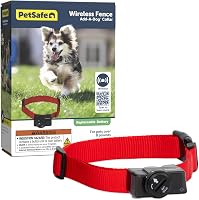
Choose this PetSafe system for a circular home play area and a replaceable battery routine. It is a straightforward fit when an indoor transmitter can sit near the center of the space you want to use.
The range adjusts from 5 to 90 ft in all directions from the base. That flexibility helps you shrink the circle to fit the property, although it cannot change the shape.
The waterproof receiver has tone-only mode and 5 adjustable static correction levels. Static-free reentry lets a dog return without correction after crossing the boundary.
Its RFA-67D-11 battery lasts up to 2 months, with a low-battery indicator to prompt replacement. Keep the correct spare available if changing a battery is easier for your household than routine charging.
Additional compatible receiver collars let more dogs share the system. Each dog still needs separate fitting and boundary lessons.
Skip it if a circle wastes most of your usable yard or extends toward a hazard. It also does not suit someone who specifically wants a rechargeable receiver or app-drawn property shape.
PetSafe Stay & Play Compact wireless fence, up to 3/4 acre
Choose Stay & Play Compact for more circular coverage and a rechargeable collar. Its LCD display shows the range and warning indicators, which makes the transmitter's status easier to check.
The adjustable range runs from 22 to 105 ft in all directions. Check the minimum as well as the maximum if your intended play area is small.
Its waterproof receiver suits smaller dogs than the other systems here, subject to the neck fit shown above. The rechargeable battery is nonreplaceable, so that battery design should be part of your long-term buying decision.
Static-free reentry is included. You can also add receiver collars for other pets using the same wireless system.
Both PetSafe transmitter models are portable where you have an outlet and an appropriate indoor location. Moving either system still means checking the new boundary and teaching your dog where it is.
Skip Stay & Play if you need a custom shape, cannot provide a suitable transmitter location, or prefer a user-replaceable collar battery. Extra coverage will not solve those mismatches.
Dogtra GPS Fence
Choose Dogtra for a custom boundary on a suitable larger property, especially if you want the collar to operate independently after setup. The app supports circular or custom shapes and stores up to 30 fences.
Dogtra uses a warning zone, a primary fence, and 2 backup fences. Its minimum property size leaves room for those zones and for the dog to respond.
Each boundary can use tone, vibration, or stimulation, with 100 adjustable stimulation levels. The return sequence disables correction as the dog comes back and uses a reminder tone.
Dogtra describes typical GPS accuracy as 3–15 ft and recommends a wide, open area with a clear sky view. Allow space for position variation rather than tracing a boundary directly beside a road.
The rechargeable collar has an IPX9K waterproof designation, and Dogtra describes its battery as lasting all day. Up to 3 dogs can share a fence profile through the app.
There is no live tracking or notification feature. Route and distance history available after use should not be confused with finding an escaped dog in real time.
Skip Dogtra for a smaller property, indoor use, or escape alerts. Remove the collar indoors, keep app and collar firmware current, and include separately sold training flags in your setup plan.
PetSafe Guardian GPS dog fence, 3/4 acre+
Choose Guardian for home-based GPS containment and less frequent charging when your dog meets its larger size requirements. The My PetSafe app handles fence design, battery monitoring, collar settings, and notifications.
Guardian combines GPS satellite data with motion detection and AI through PetSafe's AccuGuard system. Those features do not remove the need to check your planned boundary and train your dog.
The waterproof, rechargeable collar offers tone and vibration or 10 static levels. PetSafe states up to 5 days of battery life on a charge.
This model has no subscription fee, tracking, or portability features. Its app notifications should not be read as a promise of live escape tracking.
Additional Add-A-Dog collars are available. Check each dog's measurements before choosing the system for a household with different-sized dogs.
Skip Guardian if you want a fence for changing travel destinations, need live location, or have a dog below its size limits. Its longer stated battery interval is useful only after those basic needs match.
How do you set up a wireless dog fence correctly?
Set up the equipment and check the entire boundary before your dog wears the active collar. Allow separate time for installation and training, even when the hardware can be ready within a few hours.
1. Plan the safe area on the ground
Walk the intended play area and identify roads, gates, water hazards, driveways, and neighboring property. Decide where your dog should turn back before choosing the final boundary.
Leave a clear return route toward the safe area. Avoid creating a narrow corner where the dog has little room to respond to a warning.
2. Place the transmitter or create the GPS boundary
For a transmitter model, follow the indoor placement instructions and choose a location you can leave undisturbed. Furniture changes or a more convenient outlet should not casually move the center of your dog's learned boundary.
For GPS, follow the app's setup steps and the brand's sky-view requirements. Draw the usable area with space for warning zones rather than outlining the largest possible map shape.
3. Check the collar response without your dog
Use the brand's boundary-check procedure and any included checking tool. Walk the perimeter as instructed, including corners and areas near structures.
Make sure the cues occur where you expect. If a section is inconsistent or leaves too little safe space, revise the setup before starting lessons.
4. Mark the boundary and begin lessons
Place flags according to the training guide so the boundary has a visible reference. The 2 PetSafe transmitter kits include flags, while Dogtra flags are sold separately.
Use a leash during early lessons and reward your dog for moving back into the safe area. Keep sessions short enough that the dog can learn without becoming overwhelmed.
Progress through the brand's training stages rather than setting a fixed deadline. A quick equipment installation does not mean a dog understands the fence that afternoon.
5. Teach normal exits separately
Plan how your dog will leave for walks, car rides, or appointments. Follow the brand's instructions for collar removal and crossing the boundary.
Use a consistent departure routine so the dog is not asked to ignore the same boundary unpredictably. Everyone in the household should use that routine.
How do you care for the collar and keep the boundary useful?
Build a brief pre-use check and a regular care routine. A fence needs power, correct fit, and a stable setup each time your dog uses it.
Before outdoor time, check battery status and confirm that the system is operating normally. For transmitter models, also make sure the base still has power.
Inspect the strap, buckle, contact points, and charging area as directed. Clean and dry the collar using the brand's care instructions, especially before charging.
A waterproof collar still needs proper care. Follow its instructions for water exposure, cleaning, drying, and charging rather than assuming every part can be handled the same way.
Recheck the boundary after moving a transmitter, editing a GPS fence, or changing the equipment setup. Repeat the relevant training steps if the learned line has changed.
Make collar removal and storage part of the household routine. Dogtra is for outdoor use only because walls and ceilings can interfere with GPS reception.
If someone else cares for your dog, show them the charging routine, collar fit, and exit procedure. Leave clear instructions about which area the dog can use and how to respond if the system signals a fault.
What common mistakes lead to a poor fence choice?
The biggest mistakes are buying by acreage alone and expecting the collar to replace training. Most other problems follow from overlooking the yard, the dog, or the daily care routine.
Buying the largest coverage number
More coverage helps only if its shape fits. A large circle that reaches across a road is less useful than a smaller boundary fully inside a suitable play area.
For GPS, also respect the minimum property size. A system intended for a larger area should not be squeezed into a smaller yard just because the app lets you draw a shape.
Expecting stronger correction to solve confusion
A dog that does not understand the return direction needs clearer lessons. Raising the setting can make the yard more confusing rather than teaching the missing skill.
Pause if your dog appears distressed or avoids the play area. Revisit the training guide and seek help before continuing.
Assuming wireless means suitable for every trip
Portability is a model-specific feature. A portable transmitter still needs power and an indoor placement, and a new destination still needs boundary checks and training.
Do not assume a saved GPS shape makes an unfamiliar property ready for use. Check local hazards and the system's requirements at each location.
Treating containment as an escape-recovery plan
A boundary collar may have no way to tell you where your dog went. Decide before buying how you would locate and recover your dog after an escape.
Keep identification current and assess whether separate live tracking fits your needs. A tracking feature also needs its own coverage and battery routine.
What does a wireless dog fence cost to own?
Compare equipment, extra collars, power needs, and replacement parts across your shortlist. A subscription-free fence can still have ongoing ownership needs.
For a multi-dog household, confirm which receiver collars are compatible before buying them separately. Plan training time for each dog rather than treating extra collars as a complete setup.
Replaceable batteries create a repeat expense and require spares. Rechargeable systems need a charging routine, and a nonreplaceable battery deserves attention when you compare long-term care.
Both GPS fences here work without monthly subscriptions, but neither includes live tracking. If you add a tracker, assess its service plan separately.
For the wider cost picture, read how much a dog fence costs. Our guide to whether GPS dog fences need a monthly plan explains how containment and connected services differ.
When should you choose a physical fence instead?
Choose a physical barrier when you need to block movement or control access to the yard. A collar boundary cannot stop another animal from entering or prevent a visitor from approaching your dog.
A physical fence also deserves priority beside traffic, where the consequences of crossing are high. The same applies when your dog repeatedly ignores boundary cues or cannot learn them calmly.
Check whether gates, supervision, or a smaller enclosed run would better solve the problem. You do not have to offer the whole property for the outdoor space to be useful.
Which wireless dog fence should you choose?
Choose your wireless dog fence by yard fit first, dog fit second, and daily care third. Eliminate unsuitable systems before weighing displays, app controls, or battery convenience.
- Choose PetSafe Wireless when a modest circle fits and you prefer replaceable batteries.
- Choose Stay & Play Compact when you need more circular coverage or its smaller-dog fit, with a rechargeable receiver.
- Choose Dogtra for a suitable larger outdoor property, custom shapes, and independent collar operation after setup.
- Choose Guardian for home-based GPS containment when your larger dog fits and its charging interval suits your routine.
If none leaves a safe, useful play area, change the containment approach. Do not stretch a boundary toward a hazard to make a chosen product fit.
Compare the shortlist in our best wireless dog fences and best GPS dog fences. Before ordering, settle the transmitter location or proposed GPS boundary, measure your dog's neck, and assign responsibility for collar care.
Sources
Frequently asked questions
What is the difference between a wireless dog fence and a GPS dog fence?
A transmitter-based wireless fence creates a circle around an indoor base unit, while a GPS fence uses satellite position and an app-set boundary; both use a receiver collar to deliver cues near the edge. Choose by usable yard shape, collar fit, and signal conditions rather than acreage alone.
Do wireless dog fences work?
Wireless dog fences can help a trained dog learn a boundary, but they cannot physically stop an escape; success depends on a suitable yard, correct setup, consistent training, and a working collar. If your dog cannot respond calmly to boundary cues, use another containment method and seek qualified training help.
Does a GPS dog fence need a subscription?
Some GPS fences work without a subscription, including the Dogtra and Guardian models covered here; neither includes live tracking, so a fee-free fence does not also solve escape recovery. Compare containment, location tracking, app access, and any separate service plan as distinct parts of your buying decision.
Can a wireless dog fence cover an irregular yard?
A GPS fence with custom boundaries can suit an irregular yard better than a circular transmitter system; the property still needs enough usable space and suitable satellite reception. A narrow strip beside a road may remain unsuitable even if you can draw it on the app map.
Can a GPS dog fence track a dog that leaves the boundary?
Only a system with location-tracking features can serve that purpose; GPS containment alone does not include it. Dogtra has no live tracking or notifications, and this Guardian model has no tracking; if escape recovery matters, compare a separate tracker and its coverage needs before choosing your fence.