7 Best Wireless Dog Fences for Small Dogs (November 2026)
The best wireless dog fences for small dogs include the PetSafe Wireless Dog Fence for compact round yards, the PetSafe Stay & Play Compact wireless fence for dogs under 8 lb, and the PetSafe Wireless Pet Containment System collar for another household dog.
On this page (9 sections)
- How we chose wireless dog fences for small dogs
- Which wireless dog fence fits your small dog?
- How should a wireless dog fence collar fit a small dog?
- Will the boundary fit inside your usable yard?
- How do you set up a small-dog fence without confusing your dog?
- What do the warning modes mean in daily use?
- What care does a wireless fence need?
- Which common buying mistakes should you avoid?
- Which wireless dog fence should you pick for a small dog?
The PetSafe Wireless Dog Fence, up to 1/2 acre is our top-scoring wireless dog fence for small dogs weighing at least 8 lb whose yards suit a circle. For dogs weighing 5 to 7 lb, choose the PetSafe Stay & Play Compact if its collar fits.
Start with your dog's size and your yard's usable shape. A larger coverage claim or more correction settings won't make an unsuitable collar or boundary work.
None of these picks has a confirmed fit for dogs under 5 lb. One is an add-on collar, so it also needs a compatible transmitter before it can serve as a fence.
Our complete guide to wireless and GPS dog fences explains the main options. Read how wireless dog fences work if you're new to transmitter boundaries.
Our picks at a glance
-
1
 Best for compact round yards
PetSafe Wireless Dog Fence, up to 1/2 acre
8.9/10 our score
See it on Amazon -
2
 Best for dogs under 8 lb
PetSafe Stay & Play Compact wireless fence, up to 3/4 acre
8.7/10 our score
See it on Amazon -
3
 Best for another household dog
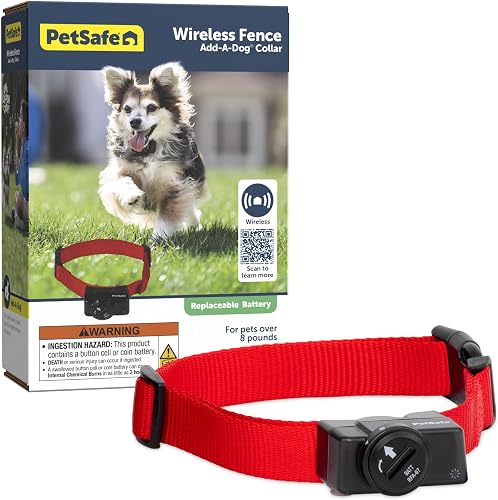
PetSafe Wireless Pet Containment System collar
8.6/10 our score
See it on Amazon
- 4
 Check it
PetSafe Stay & Play wireless fence for stubborn dogs
Best for persistent small dogs - 5
 Check it
DOGOITM GPS wireless dog fence
Best for larger small dogs - 6
 Check it
Dwarfuarm GPS wireless dog fence
Best for open irregular properties - 7
 Check it
MIMOFPET wireless fence for small dogs
Best for supervised portable use
How we chose wireless dog fences for small dogs
We prioritized dog fit, boundary shape and daily upkeep because those decide whether a system belongs on your shortlist. Scores reflect those features and their usefulness for this search.
A lower-ranked product can still suit a specific household better. The Compact's lower weight threshold, for example, matters more than the standard kit's higher score if your dog is too light for it.
We also separated complete kits from extra receivers and automatic fence warnings from remote training controls. Those distinctions prevent buying equipment that doesn't do the job you expect.
Which wireless dog fence fits your small dog?
Choose a complete kit that meets both your dog's size requirements and your yard's layout. Use the table to narrow the choices, then read the practical limits below.
| Product | Best for | Minimum dog weight | Boundary | Collar | Our score |
|---|---|---|---|---|---|
| PetSafe Wireless Dog Fence, up to 1/2 acre | compact round yards | 8 lb | Circular, up to 1/2 acre | Waterproof, replaceable battery | 8.9 |
| PetSafe Stay & Play Compact wireless fence, up to 3/4 acre | dogs under 8 lb | 5 lb | Circular, up to 3/4 acre | Rechargeable, waterproof | 8.7 |
| PetSafe Wireless Pet Containment System collar | another household dog | 8 lb | Uses compatible transmitter boundary | Waterproof, replaceable battery | 8.6 |
| PetSafe Stay & Play wireless fence for stubborn dogs | persistent small dogs | 5 lb | Circular, up to 3/4 acre | Rechargeable, waterproof | 8.3 |
| DOGOITM GPS wireless dog fence | larger small dogs | 15 lb | Circular or polygon | Rechargeable, IPX7 waterproof | 7.2 |
| Dwarfuarm GPS wireless dog fence | open irregular properties | 15 lb | Circular or 3–16 point custom | Rechargeable, IPX7 waterproof | 6.8 |
| MIMOFPET wireless fence for small dogs | supervised portable use | Adjustable range from 25 to 3,500 ft | Rechargeable, IPX7 waterproof | 6.8 |
PetSafe Wireless Dog Fence, up to 1/2 acre: Best for compact round yards
- Fits pets 8 lb and up
- Circular coverage up to 1/2 acre
- Waterproof collar
- Tone-only mode plus 5 correction levels
A complete transmitter kit for dogs weighing at least 8 lb and yards that can fit a circle. Choose it if you prefer replacing a collar battery to maintaining a charging routine.
Pros
- Adjustable circular boundary
- Static-free reentry
- Low-battery indicator
Cons
- Not for dogs under 8 lb
- Requires an outlet and indoor transmitter space
The standard PetSafe kit suits a small dog weighing 8 lb or more, with a neck measuring 6–28 in. It creates up to 1/2 acre of circular coverage around a plugged-in indoor transmitter.
Its useful distinction for compact yards is the adjustable radius of 5–90 ft. That gives you room to shrink the circle, although the transmitter's position still decides where that circle falls.
The waterproof receiver has tone-only mode and 5 correction levels. PetSafe says the replaceable battery lasts up to 2 months, and a low-battery indicator helps you plan a change.
Choose this kit if you prefer keeping a spare battery over remembering to charge a receiver. Static-free reentry also lets a dog that passes the boundary return without another correction.
Skip it for a dog below its weight limit or a yard that needs a long, narrow play area. Portability is useful at a vacation home with an outlet, but every new location still needs boundary checks and fresh training.
PetSafe Stay & Play Compact wireless fence, up to 3/4 acre: Best for dogs under 8 lb
- Fits dogs 5 lb and up
- Circular coverage up to 3/4 acre
- Rechargeable waterproof collar
- LCD coverage display
The clearest starting point here for dogs weighing 5 to 7 lb. Its rechargeable receiver and LCD range display also suit owners who want charging and setup checks in their routine.
Pros
- Lower minimum weight than standard kit
- LCD range and error display
- Static-free reentry
Cons
- Cannot trace an irregular property line
- Rechargeable collar needs planned charging
The Stay & Play Compact is the strongest starting point here for a dog weighing 5–7 lb. Its rechargeable, waterproof receiver fits necks measuring 6–28 in, so measure rather than assuming the lower weight limit settles fit.
Coverage reaches up to 3/4 acre, with a circular radius adjustable from 22–105 ft. That minimum matters: a system with greater maximum coverage can still be less suitable for a very tight space.
The indoor transmitter's LCD shows the selected range and warning indicators for system errors. It helps with setup checks, but you still need to walk the boundary to see where it falls.
Choose it if you want a rechargeable complete kit and can build charging into your routine. Its static-free reentry is another useful feature if your dog crosses the line and returns.
Skip it if you need to trace property corners or have no suitable outlet and indoor transmitter location. PetSafe's 1–2 hour setup estimate covers equipment setup, not the time your dog needs to learn the boundary.
PetSafe Wireless Pet Containment System collar: Best for another household dog
- Fits pets 8 lb and up
- Works with PetSafe Wireless Fence transmitters
- Tone-only mode plus 5 static levels
- Waterproof collar
An extra or replacement receiver for an existing PetSafe Wireless Fence, rather than a complete fence. Check each dog's fit separately before adding a collar.
Pros
- Compatible with all PetSafe Wireless Fence transmitters
- Short and long contact points included
- Low-battery indicator
Cons
- No transmitter included
- Not compatible with PetSafe In-Ground Fences or Remote Trainers
This PetSafe receiver is the right kind of purchase when you already have a compatible wireless transmitter. It adds another dog to that system or replaces an existing receiver; it cannot create a boundary by itself.
The waterproof collar fits pets weighing at least 8 lb, with necks measuring 6–28 in. Its replaceable battery has a low-battery indicator, and PetSafe gives a 1–3 month battery estimate depending on use.
Tone-only mode, 5 static levels, and included short and long contact points let you set up the receiver for the individual dog. Don't copy another dog's fit or settings just because both use the same transmitter.
It works with all PetSafe Wireless Fence transmitters, but not PetSafe In-Ground Fences or Remote Trainers. Check the system family before ordering, since the PetSafe name alone doesn't guarantee compatibility.
Skip this receiver if you're buying your first complete fence. Our PetSafe Stay & Play Compact review covers a kit that includes the transmitter.
PetSafe Stay & Play wireless fence for stubborn dogs: Best for persistent small dogs
- Fits dogs 5 lb and up
- Circular coverage up to 3/4 acre
- Tone-only mode plus 5 correction levels
- Rechargeable waterproof collar
PetSafe's option for persistent pets combines a low minimum weight with adjustable correction settings. Choose it for a clear training need, rather than assuming every escape attempt calls for a different collar.
Pros
- Tone-only training option
- Short and long contact points included
- Static-free reentry
Cons
- Circular boundary only
- Requires careful, gradual boundary training
The Stay & Play for Stubborn Dogs is PetSafe's option for persistent pets that need a deliberate training plan. It fits dogs from 5 lb with necks measuring 6–28 in and provides up to 3/4 acre of circular coverage.
Its rechargeable waterproof receiver includes tone-only mode and 5 static correction levels. Short and long contact points come with the kit, along with training flags and a tool for checking the receiver.
Choose it when the persistent-dog design matches a clear need and you're prepared to follow the training instructions closely. Static-free reentry allows a dog to return without correction after crossing the boundary.
Skip it as an automatic response to chasing, fear or poor recall. Before changing equipment or settings, check that the collar fits, the boundary works as intended and the dog understands the warning.
The Compact remains the simpler starting choice for readers who mainly need a lower minimum weight and rechargeable collar. A persistent dog still needs a suitable yard, patient lessons and supervision while learning.
DOGOITM GPS wireless dog fence: Best for larger small dogs
- Fits dogs 15–120 lb
- Circular and polygon boundary modes
- Rechargeable collar
- GPS positioning
A GPS choice for larger small dogs that meet its weight and neck requirements. Its polygon mode offers shape control, while circular mode needs more space than many compact yards allow.
Pros
- Separate memory for both boundary modes
- No app download or monthly fee
- Rechargeable collar
Cons
- Not for dogs under 15 lb
- Polygon setup requires 6 non-crossing points
DOGOITM suits a larger small dog on property where custom boundaries help. It fits dogs weighing 15–120 lb, with a stated dog-fit neck range of 10–28 in.
Circular mode starts at a 65 ft radius, so it isn't a shortcut for a tiny yard. Polygon mode uses 6 points joined in sequence into a closed shape, with no crossing lines.
The modes have separate memory, allowing saved shapes to remain when you switch between them. That helps if you use both layouts, but you should still confirm the active mode before letting your dog use the area.
The rechargeable collar has an IPX7 waterproof rating, and the system needs no app download or monthly fee. DOGOITM claims up to 50 hours of use per charge; plan charging around actual use.
Skip it for lighter dogs or locations without suitable outdoor satellite reception. Our GPS vs wireless dog fence guide explains why shape flexibility and reception need to be considered together.
Dwarfuarm GPS wireless dog fence: Best for open irregular properties
- Fits dogs 15–110 lb
- Circular and custom multi-point modes
- GPS collar with no subscription
- IPX7 waterproof
Consider this collar for a dog meeting its size limits on open land where a custom perimeter helps. Dense woods and obstructed outdoor spaces are poor matches.
Pros
- Custom boundary with 3–16 points
- Vibration and static can be disabled
- No app subscription or monthly fee
Cons
- Not for dogs under 15 lb
- Needs open outdoor space with a clear sky view
Dwarfuarm is worth considering for an open, irregular property and a dog weighing 15–110 lb with a 10–26 in neck. Its custom mode accepts 3–16 points, with adjacent points at least 16 ft apart.
That spacing matters around small corners and narrow sections. More boundary points give you choices, but they don't mean you can trace every tight turn in a compact yard.
Circular mode starts at a 49 ft radius. Dwarfuarm recommends a clear sky view and warns that dense woods, tall buildings and heavy obstructions can weaken reception and affect accuracy.
The collar offers beep, vibration and adjustable static modes; vibration and static can each be set to 0. It is rechargeable, rated IPX7 waterproof and requires no app subscription or monthly fee.
Choose it for open space where the custom layout adds usable room. Skip it for wooded surroundings, indoor use or dogs below its size limits, and read about GPS dog fences in wooded areas before planning a shaded perimeter.
MIMOFPET wireless fence for small dogs: Best for supervised portable use
- Fence mode uses beep and vibration warnings
- Separate remote training modes
- Adjustable boundary range
- Rechargeable collar
A portable option for owners who want automatic beep and vibration boundary warnings plus separate remote training controls. Confirm minimum weight and neck fit before choosing it for a small dog.
Pros
- No automatic static in fence mode
- Remote keypad lock
- Separate remote training controls
Cons
- Minimum weight and neck fit need confirmation
- Moving the remote moves the boundary center
MIMOFPET suits owners seeking beep and vibration boundary warnings with separate remote controls. Its automatic fence mode has no static correction, even though static is available through remote training.
The remote is the signal center, with 14 boundary range levels from 25–3,500 ft. Moving it moves the center, so carrying it around the property changes the area your dog is learning.
Choose it for supervised portable use when you can keep that position clear and consistent. The keypad lock helps prevent accidental commands, which matters when the remote also controls training functions.
The receiver is rechargeable and rated IPX7 waterproof. MIMOFPET's long standby claims aren't a guide to continuous fence use, since enabling the boundary function uses more power.
Confirm minimum dog weight and neck fit before buying. Skip it if you need a verified fit from the information here, or if you expect a fixed property boundary while carrying the remote between locations.
How should a wireless dog fence collar fit a small dog?
A suitable wireless dog fence for small dogs must meet both weight and neck-fit requirements without leaving the receiver awkwardly positioned. A small-dog label doesn't replace those checks.
Measure before choosing a small-dog wireless fence
Measure your dog's neck where the manufacturer instructs the receiver to sit. Compare that measurement with the adjustment range, then follow the fitting directions for strap tension and contact placement.
Meeting the lower weight limit doesn't show how comfortably your dog will carry the receiver. Watch for rubbing, restricted movement or a unit that shifts out of place during normal activity.
Don't tighten the strap beyond the instructions to solve poor contact. Use the recommended contact points for the coat, and reassess the fit if the receiver won't stay correctly positioned.
Treat growth and changing coats as fit changes
Recheck fit as a young dog grows or after grooming changes the coat around the neck. A strap setting that worked earlier may no longer keep the receiver in the right place.
None of these choices should be forced onto a dog below its stated minimum. Use a leash or suitable physical enclosure if no receiver meets your dog's requirements.
Will the boundary fit inside your usable yard?
The right boundary leaves room to play and a buffer from hazards within space your dog is allowed to enter. Total acreage alone doesn't answer that question.
Draw the circle before choosing a transmitter kit
Mark a possible indoor transmitter location on a simple yard sketch, then draw the proposed circle around it. Check the closest road, driveway, neighboring property and open gate before thinking about maximum coverage.
A long yard may lose much of its usable space inside a circle. Increasing the radius to reach the far end can also push the sides beyond your property.
Transmitter placement is therefore part of the purchase decision. An outlet in the wrong part of the house can limit the circle you can create.
Check GPS reception where the boundary will run
GPS needs suitable outdoor reception along the proposed perimeter, not just in the middle of an open lawn. Trees and nearby structures deserve attention before you commit to a custom shape.
Custom points also need room between them and nearby hazards. Keep the boundary back from danger rather than assuming a virtual line can act like a wall.
Read whether GPS dog fences work for the broader limits. If your yard needs precise edges in obstructed space, compare the options in our wireless, GPS and wired fence guide before choosing.
How do you set up a small-dog fence without confusing your dog?
Set up and check the equipment before introducing your dog to the boundary. Equipment installation and boundary learning are separate jobs.
- Choose the safe play area. Leave space away from traffic and other hazards, and decide how you'll take your dog out for walks.
- Prepare the power supply. Install the correct receiver battery or fully charge it, then position the transmitter or remote as instructed.
- Set the boundary without your dog wearing the receiver. Use the manufacturer's checking procedure and included tools where applicable.
- Walk the whole perimeter. Check corners, paths and the edges nearest hazards rather than checking only the most open section.
- Place training markers as directed. These give you and your dog a visible reference while learning.
- Begin short, supervised lessons. Follow the manual's sequence and use a leash to keep control during early sessions.
Teach your dog to turn back toward the safe area and reward that response. Don't deliberately let the dog cross the line to see what happens.
If your dog freezes, avoids the yard or becomes distressed, stop the session and review the approach. Increasing correction without resolving confusion can make the yard harder to learn.
Decide on a consistent exit routine for walks, following the system's instructions. A dog needs a clear difference between supervised departure and ordinary play inside the boundary.
When moving a portable system, repeat the equipment checks and introduce the new area. Familiar equipment doesn't make a new campsite or vacation yard familiar to your dog.
What do the warning modes mean in daily use?
Choose warning settings around the automatic fence response, not the number of functions on a remote. A manual command and a boundary-triggered warning do different jobs.
Tone-only mode gives you a way to introduce the warning sound during lessons. Vibration is another signal, but it can still startle a sensitive dog.
Follow the instructions for any correction settings and avoid assuming that a small dog needs the same approach as another dog. Coat contact, fit and a clear lesson all matter before changing intensity.
MIMOFPET illustrates why this distinction matters: its remote training choices don't change its beep-and-vibration automatic fence mode. Choose it because that boundary response matches your plan.
Electronic fences also don't physically block an exit or stop another animal from entering. Static-free reentry helps a dog return, but it doesn't make crossing the boundary safe.
What care does a wireless fence need?
A wireless fence needs routine fit, power and boundary checks, even after your dog learns the yard. Waterproofing doesn't remove the need for care.
Check the collar's charge or battery status before use. Replaceable-battery systems need a spare ready, while rechargeable systems need a charging period when your dog is secured another way.
Remove and clean the collar as the manual directs, and check the skin beneath the strap. Follow the stated wear limits instead of leaving a contact-point receiver on continuously.
Keep charging contacts clean and follow the drying instructions before charging. Inspect straps, contact points and charging cables for wear.
Recheck operation after a power interruption, transmitter move or boundary change. If the system behaves unexpectedly, secure your dog with a leash or enclosure until you've resolved the cause.
Which common buying mistakes should you avoid?
Avoid choosing by maximum range, product name or correction levels alone. Each can distract from a mismatch that matters more.
- Buying an extra receiver as a complete fence. The PetSafe add-on collar needs an existing compatible transmitter.
- Overlooking the smallest boundary. A large advertised area doesn't tell you whether the system can shrink enough for your yard.
- Treating standby time as operating time. Active fence use draws power differently, so plan around the mode you'll actually use.
- Moving the signal center casually. Changing a transmitter or remote position changes what your dog must learn.
- Assuming portability means instant familiarity. Every location needs its own safe layout and introduction.
- Using a fence to replace supervision too soon. Reliable responses during calm lessons don't prove readiness around every distraction.
For multiple dogs, assess each receiver and training plan separately. One dog's progress doesn't show that another understands the same boundary.
Which wireless dog fence should you pick for a small dog?
Pick the standard PetSafe kit when your dog meets its fit requirements, you prefer replaceable batteries and its circle fits your yard. Choose the Stay & Play Compact for a lighter eligible dog or a rechargeable complete kit.
For an existing compatible PetSafe Wireless Fence, buy the add-on receiver rather than another complete system. Consider the stubborn-dog kit when its intended use matches a clear training need.
Choose DOGOITM or Dwarfuarm only when your dog meets their larger size requirements and outdoor reception suits the planned boundary. MIMOFPET belongs on the shortlist for supervised portable use after you confirm fit and accept its moving signal center.
The best wireless dog fence for small dogs is the one that fits the dog, stays within safe usable space and matches a routine you can maintain. If those conditions don't line up, choose a physical enclosure or leash instead.
For a second household dog, continue with our wireless dog fence for 2 dogs guide.
Our top 3 picks at a glance
-
1
Best for compact round yards
PetSafe Wireless Dog Fence, up to 1/2 acre
8.9/10 our score
See it on Amazon -
2
Best for dogs under 8 lb
PetSafe Stay & Play Compact wireless fence, up to 3/4 acre
8.7/10 our score
See it on Amazon -
3
Best for another household dog
PetSafe Wireless Pet Containment System collar
8.6/10 our score
See it on Amazon
Frequently asked questions
What is the smallest dog a wireless fence can fit?
The lowest stated minimum among these picks is 5 lb, shared by both PetSafe Stay & Play models; none has a confirmed fit for dogs under that weight. Measure your dog's neck as well, since a suitable weight does not guarantee that the receiver and strap will fit comfortably.
Is a GPS fence or a transmitter fence better for a small yard?
A transmitter fence is the better starting point when its circle fits within your usable yard; GPS adds custom shapes, but the GPS collars here start at 15 lb and need suitable outdoor reception. Compare the smallest usable boundary and space for a safety buffer before deciding.
Can I use a wireless dog fence for a puppy?
Only consider one after your puppy meets the system's weight, neck-fit and training requirements; a minimum weight is not an age or readiness guideline. Follow the manufacturer's instructions, introduce boundary lessons gradually, and use a leash or physical enclosure while your puppy is still learning the yard.
Do wireless dog fences work with a small, irregular yard?
A circular wireless fence works only if you can keep the whole usable boundary inside the space your dog may enter; custom GPS shapes offer another option for suitable dogs and open areas. If neither leaves enough room away from hazards, choose a physical enclosure or consider a wired boundary.
Will an electronic fence keep other dogs out?
No; an electronic boundary communicates with the receiver your dog wears; it does not form a barrier against other animals or people. Keep that limit in mind beside sidewalks, shared yards and places with loose dogs; a physical fence serves a different purpose and may still be needed.